
What is Cryptocurrency? The Simple Beginner’s Guide Nobody Gives You
Introduction: The First Step into the World of Cryptocurrency
You’ve probably heard the buzz. Maybe from a friend, the news, or online. Words like Bitcoin, blockchain, and crypto pop up everywhere. And if you’re like most people just starting, your first thought is simple: "What does crypto even mean?"
It can feel like a secret club with its own confusing language.

Technical jargon, talk of a volatile crypto market crash, and constant warnings about scams make it seem like a minefield. It’s no wonder many feel overwhelmed before they even begin.
So let’s break it down to the very basics. In simple terms, cryptocurrency is digital money. Unlike the dollars or euros in your bank, it’s a form of currency designed to work without a central authority like a government or bank. Instead, it uses a technology called blockchain to securely record transactions, as explained in this guide from security experts at Kaspersky.
Think of it as a new, internet-native way to store and exchange value. But here’s the thing everyone forgets to tell beginners: understanding the crypto meaning is just step one. The real challenge is navigating the space safely and confidently.
That’s where this guide comes in. We’ve built it specifically for you—the everyday person who wants to learn without the hype, fear, or confusion. We’ll walk you through everything from setting up your first wallet to understanding why you might see headlines about a crypto sell off.
To make your journey even smoother, we recommend starting with a free resource like the Clicks and Trades newsletter. It delivers step-by-step crypto education and safety tips right to your inbox, perfect for building your knowledge at a comfortable pace.
Ready to finally understand it all? Your clear, trustworthy path starts right here. For a full walkthrough of the absolute fundamentals, check out our detailed guide on crypto for beginners.
Sign Up for free guidance and take your first confident step today.
What is Cryptocurrency? A Simple Definition
Let’s answer that big question with a simple image. Imagine cash, but it only exists on computers and the internet. That’s the core idea of cryptocurrency. It is digital money.

The "crypto" part comes from cryptography, which is a method of using complex math to secure information. Think of it as a super-strong digital lock and key system that keeps your money safe and verifies every transaction.
Unlike the dollars in your bank account, no single company, government, or bank prints it or controls its value. Instead, it runs on a decentralized network of thousands of computers all over the world. This system is called a blockchain. You can think of a blockchain as a shared public notebook that records every single transaction. Once something is written in this notebook, it is nearly impossible to erase or change, making it very secure. Experts at Kaspersky describe it as a digital payment system that doesn’t rely on banks for verification.
How is it Different from Regular Money?
Here is the main difference in a simple table:
| Traditional Money (Euro, Dollar) | Cryptocurrency (Bitcoin, Ethereum) |
|---|---|
| Issued and controlled by a central bank (like the ECB or Federal Reserve). | Created and governed by code and a decentralized network of users. |
| Exists as physical cash and digital numbers in a bank database. | Exists only as digital entries on a blockchain. |
| Banks act as middlemen to approve and record transactions. | Transactions are peer-to-peer, verified by the network itself. |
This decentralized nature is what makes crypto unique. As financial guides point out, these are digital currency units designed to function independently.
Why Does the Price Go Up and Down So Much?
Since no central authority controls it, the value of a cryptocurrency is based on what people believe it is worth. This is driven by supply, demand, news, and how useful people think it will be in the future.
When lots of people want to buy, the price often goes up. When many people sell, the price can drop quickly, which is what headlines call a crypto sell off or a crypto market crash. Questions like "why is crypto crashing" often pop up during these volatile weeks. These price swings can be influenced by many factors, including overall market sentiment during a turbulent crypto week or shifts in crypto funding rates on trading platforms.
Understanding this basic crypto meaning—digital, decentralized money—is your essential first block of knowledge. It’s the foundation for everything else, from using it safely to understanding market movements.
To build on this foundation with clear, step-by-step lessons, we recommend the free Clicks and Trades newsletter. It turns complex topics into simple, actionable guidance delivered to your inbox. For an even deeper dive into starting your journey the right way, continue with our full guide on crypto for beginners.
Ready to learn without the confusion? Sign Up for free today and take the next step with confidence.
The History of Cryptocurrency: From Bitcoin to Today
Now that you know the basic crypto meaning—digital, decentralized money—you might wonder where it all started. The story begins with one name: Bitcoin.
In 2009, an anonymous person or group using the name Satoshi Nakamoto created Bitcoin. It was the first successful cryptocurrency to solve a major problem: how to send digital money directly to someone without needing a bank in the middle. As explained by Coinbase, Bitcoin enabled secure, peer-to-peer transactions over the internet for the first time.

For a few years, Bitcoin was mostly used by tech enthusiasts. But its success proved the idea worked. This opened the floodgates.
The Rise of Altcoins and New Ideas
Soon after Bitcoin, developers began creating alternative cryptocurrencies, called "altcoins." They aimed to improve upon Bitcoin or do something completely new. For example, Ethereum, created in 2015, introduced "smart contracts." These are like automated digital agreements that run on the blockchain, enabling entire applications to be built on top of it.
This was a huge leap. It moved crypto beyond just digital cash into a platform for decentralized apps, leading to what we now call Decentralized Finance (DeFi) and NFTs. Thousands of altcoins now exist, each with different goals.
A Rollercoaster Ride to the Mainstream
The journey hasn’t been smooth. The crypto market is famous for its extreme volatility. We’ve seen incredible boom periods, followed by sharp busts that make headlines asking "why is crypto crashing?" A major crypto market crash or a widespread crypto sell off can happen when lots of investors sell at once, often driven by fear, regulatory news, or global events. Tracking these turbulent periods week-by-week is why you often hear analysts refer to the crypto week.
These cycles are part of the market’s history. They are influenced by complex factors like investor sentiment and crypto funding rates on trading platforms. Yet, through each cycle, the underlying technology kept evolving and attracting more users.
Where Are We Now in 2026?
Today, in 2026, cryptocurrency is closer to the mainstream than ever. Major financial institutions offer crypto services, and regulations are becoming clearer in many countries. The ecosystem has exploded with innovations in DeFi, gaming, and digital ownership.
Experts remain optimistic about the future, with many predicting continued growth and adoption throughout 2026 and beyond, despite periodic market declines. For a deeper look at what beginners need to know to navigate this modern landscape, check out our complete guide on crypto for beginners.
From one digital coin to a vast global ecosystem, the history of crypto is a story of rapid innovation and growing acceptance. Understanding this past helps you make sense of its exciting, and sometimes bumpy, present.
Want to understand these market trends and crypto history with simple, step-by-step lessons? The free Clicks and Trades newsletter breaks it all down for you.
Ready to learn without the confusion? Sign Up for free today and take the next step with confidence.
How Does Cryptocurrency Work? Blockchain Technology Explained Simply
You now know where crypto came from. But how does it actually work? What makes digital money like Bitcoin secure and trustworthy without a bank checking everything?
The answer is something called blockchain. It’s the engine under the hood of every cryptocurrency. Understanding this is key to getting the full crypto meaning.
Think of a blockchain as a special kind of digital notebook. But instead of one person holding it, thousands of copies exist on computers all over the world. Every time someone sends crypto, that transaction is written down in this shared notebook. Because everyone has a copy, it’s nearly impossible to cheat or change old entries. As experts explain, a blockchain is a decentralized database that stores transaction records in a way that is transparent and secure.
What Is a Blockchain, Really?
In simple terms, a blockchain is a digital chain of information. Imagine a train where each car is a "block." Each block contains a list of recent transactions, like "Alice sent 1 Bitcoin to Bob." When a block is full, it gets linked securely to the previous block, forming a chain. This creates a permanent, unchangeable record.
This technology replaces a central authority, like a bank, with a network of participants. There’s no single point of control or failure. This is why people call it a "distributed ledger."
The Three-Step Process: How a Transaction Works
Let’s walk through what happens when you send crypto.
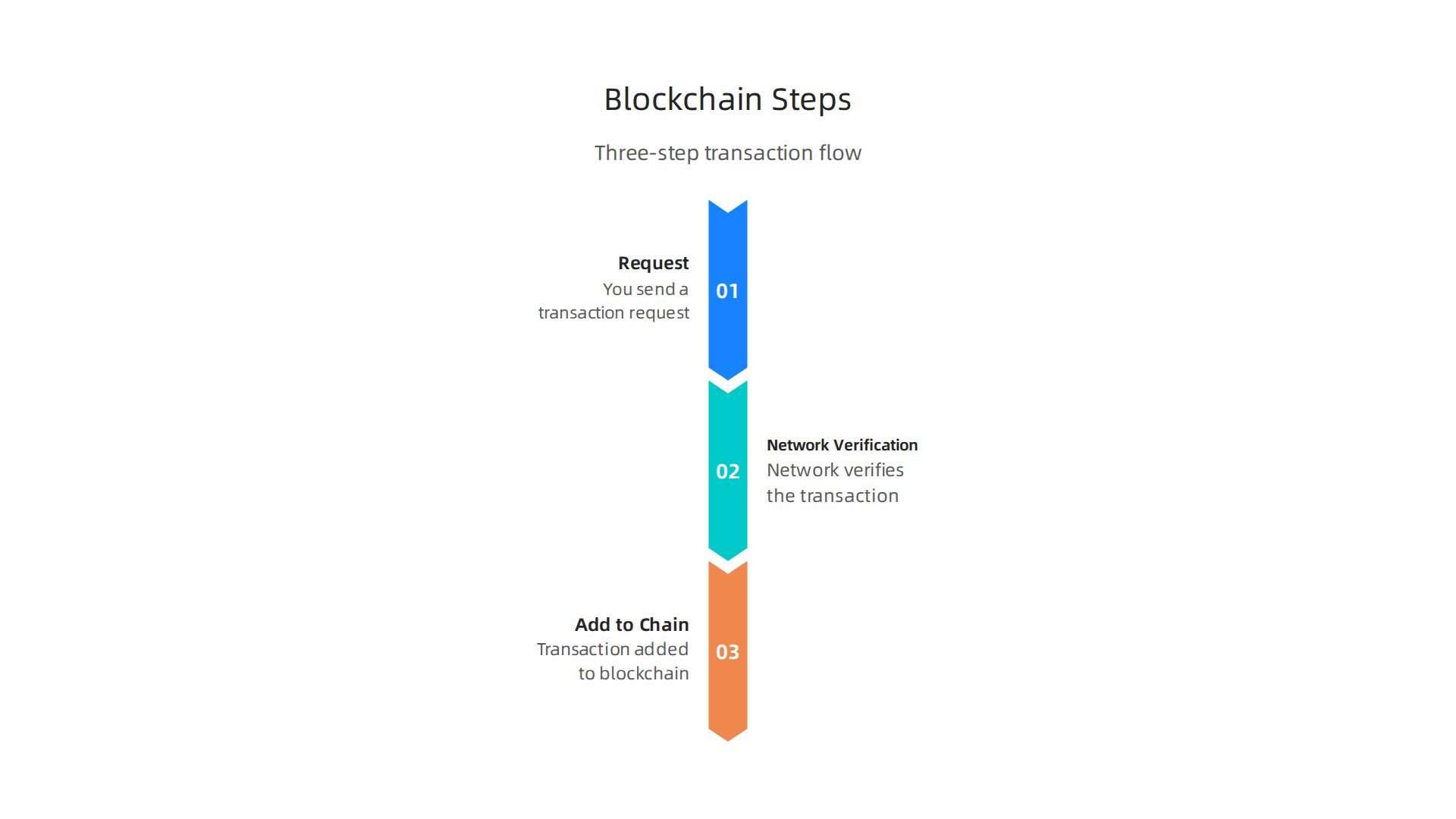
- You Make a Request. You decide to send some cryptocurrency to a friend. You sign the transaction with your private digital key, which is like a super-secure password only you know.
- The Network Checks It. Your transaction is broadcast to a global network of computers, called "nodes."

These nodes check to make sure you have the crypto to send and that your digital signature is valid. They follow the rules of the network.
3. It Gets Added to the Chain. Once verified, your transaction is grouped with others into a new "block." This block is then cryptographically sealed and linked to the existing chain. Once added, it is permanent and visible to anyone. This process of grouping transactions into secure blocks is what makes the record tamper-proof.
Who Runs This System? The Power of the Network
You might wonder, who does all this checking and sealing? It’s not a company. It’s the network itself.
- Nodes: These are the individual computers that keep a full copy of the blockchain and enforce its rules. They communicate with each other to stay in sync.
- Miners or Validators: Depending on the cryptocurrency, special participants use their computing power to solve complex puzzles. This work seals a new block to the chain. As a reward, they often earn new cryptocurrency. This process is how new coins are created and how the network stays secure from attacks.
This decentralized system is the real innovation. It means no single government or bank can freeze the network or easily alter its history. It’s run by code and cooperation.
Why Does This Matter for You?
Understanding blockchain helps you see why crypto is different from regular money in your bank.
- Security: Changing a recorded transaction would require changing that block and every single block that came after it on thousands of computers at once. That’s practically impossible.
- Transparency: Anyone can view the transaction history of most blockchains (though your personal identity is usually hidden behind a string of letters and numbers).
- Trust: You don’t have to trust a middleman. You trust the math and the network.
This technology is why we can have a crypto market crash or a major crypto sell off based on global sentiment, without a central entity stopping it. The network keeps running based on its pre-set rules. Factors like crypto funding rates on trading platforms can influence short-term trading, but the underlying blockchain ledger remains intact and secure.
So, when you hear "why is crypto crashing?" one week, remember the technology itself is still working exactly as designed. The market price is separate from the robust, ticking engine of the blockchain.
Getting a handle on this is the best first step you can take. It turns crypto from a confusing gamble into a understandable technology. For a clear, step-by-step path through all the basics, our guide on crypto for beginners breaks it down without the jargon.
The best way to learn more about how blockchains power the market each crypto week is through simple, regular lessons. The free Clicks and Trades newsletter delivers exactly that straight to your inbox.
Ready to build your knowledge with confidence? Sign Up for free today.
The Different Types of Cryptocurrencies and What They Are Used For
Now you understand the engine. But what are all the different cars that run on it? The world of cryptocurrency is not just Bitcoin. There are thousands of different types, each built for a specific purpose. Knowing the main categories is essential to grasping the full crypto meaning and how this technology is used in the real world.
While there are many ways to group them, most cryptocurrencies fall into three major buckets that you’ll see discussed every crypto week.
1. Bitcoin (BTC): Digital Gold
Bitcoin is the original. Created as a peer-to-peer electronic cash system, its primary role today is seen as a store of value, often called "digital gold." People buy and hold Bitcoin as a long-term investment, similar to gold, believing it can protect wealth over time. It’s the most recognized cryptocurrency and often sets the trend for the entire crypto market crash or boom. When people ask "why is crypto crashing?", they are often looking at Bitcoin’s price first.
2. Altcoins (like Ethereum/ETH): The Builders’ Toolkit
"Altcoin" just means "alternative to Bitcoin." This is a huge category. The most important type here are smart contract platforms, with Ethereum being the biggest example.
These cryptocurrencies aren’t just money. They are programmable blockchains that let developers build applications on top of them. Think of Ethereum as an operating system, and the apps built on it can do things like:
- Run decentralized financial services (loans, trading, earning interest).
- Create unique digital items like art and collectibles (NFTs).
- Power decentralized social media or games.
When there’s a big crypto sell off, it often affects altcoins more sharply than Bitcoin. Their value is tied to how useful and active their ecosystem is. Learning about crypto staking is a common first step to engaging with these networks.
3. Stablecoins: The Calm Anchor
This is the third crucial piece. Stablecoins are cryptocurrencies designed to have a stable price. They are typically pegged to a real-world asset like the US dollar.
Why does this matter? They provide a safe harbor within the crypto world. Instead of cashing out to regular money during volatility, traders can move funds into a stablecoin. This stability is also essential for everyday payments and for the functioning of decentralized finance apps. They help manage risk when crypto funding rates or market sentiment gets extreme.
Beyond the Big Three: A World of Tokens
The landscape keeps expanding. You’ll also hear about:
- DeFi Tokens: Power specific decentralized finance applications for lending, borrowing, or trading.
- NFTs (Non-Fungible Tokens): Represent ownership of a unique digital or physical item.
- Meme Coins: Often created as jokes or from internet culture, with prices driven heavily by community hype.
Exploring all these categories can be exciting, but it’s best to start with a solid foundation. Our guide on crypto for beginners breaks it all down without the overwhelm.
The best way to learn about these different types and their real-world uses is through consistent, simple lessons. The free Clicks and Trades newsletter delivers clear explanations straight to your inbox, helping you build knowledge week by week.
Ready to understand what each crypto actually does? Sign Up for free today.
Why is Cryptocurrency Important? Benefits and Potential Downsides
So we have all these different types of cryptocurrency. But why does any of this matter in 2026? What problem does it actually solve? Understanding the core crypto meaning is about seeing both the exciting potential and the real risks.

Think about sending money to a family member in another country. It can take days, cost high fees, and involves several banks. Cryptocurrency offers a different way.
The Key Benefits: Control and Access
The biggest advantages come from the technology itself: the decentralized blockchain.
1. More Control Through Decentralization.
A blockchain is a decentralized database, meaning no single company, bank, or government controls it. This gives you more direct control over your digital money. Transactions are verified by a network of computers, not a central authority. As explained by AWS, it’s a system for "transparent information exchange within a business network" that doesn’t rely on a single point of control. This cuts out the middleman for many types of agreements and payments.
2. Financial Inclusion for the Unbanked.
Millions of people worldwide don’t have access to a basic bank account. With just a smartphone and an internet connection, cryptocurrency can provide a way to save, send, and receive money. It opens up financial tools to anyone, anywhere, without needing permission from a traditional institution. This is a powerful shift in how we think about global finance.
The Significant Downsides: Volatility and Risk
For all its promise, cryptocurrency has major drawbacks that you must understand.
1. High Volatility.
Prices can swing wildly. A major crypto market crash can erase gains quickly, and a crypto sell off can seem to happen for no clear reason. This makes it a risky investment and a poor choice for storing money you need to be stable. When people ask "why is crypto crashing?", they’re often feeling this volatility firsthand.
2. Regulatory Uncertainty.
Governments around the world are still figuring out how to handle crypto. New rules and laws are being written, which can create uncertainty and affect prices. While many experts are optimistic for 2026, predicting growth despite market declines, the regulatory landscape is always evolving.
3. Security Risks.
If you lose the password (private key) to your crypto wallet, your money is gone forever. There’s no customer service to call for a reset. Also, while the blockchain itself is very secure, exchanges and digital wallets can be hacked. You are your own bank, and with that comes great responsibility.
A Balanced View for 2026
In 2026, cryptocurrency is not a magic solution, but it is an important new tool. It offers a vision of a more open financial system but comes with serious risks like volatility and complex security requirements.
The best way to navigate this is with steady, clear education. Trying to follow every move during a volatile crypto week is exhausting. Instead, build a solid foundation of knowledge first.
Our free guide on crypto for beginners is designed to give you that foundation without the hype or fear.
To learn about these benefits and risks in simple, weekly lessons, join the free Clicks and Trades newsletter. It breaks down the complex world of crypto into manageable steps, helping you make smarter decisions.
Ready to look at crypto with clear eyes? Sign Up for free today.
How to Buy and Store Cryptocurrency Safely
Now that you understand the potential and the risks, you might be wondering: "How do I actually get started safely?" In 2026, knowing how to buy and store your crypto is more critical than ever. It’s the difference between confidently participating in this new financial world and becoming another cautionary tale.
Getting this right is your first line of defense against scams, hacks, and simple human error. Here is your simple, step-by-step guide.
Step 1: Choose a Trusted, Regulated Exchange
Your first step is picking a safe place to buy. A cryptocurrency exchange is like a digital marketplace. Think of it as your on-ramp.
- Look for Regulation: In 2026, the most trustworthy exchanges are those regulated in major jurisdictions like the US, EU, or UK. Regulation means they must follow rules to protect your money and data. A good guide will emphasize choosing platforms with strong regulatory compliance.
- Do Your Homework: Don’t just pick the first name you hear. Read independent reviews. Look for an exchange with a long track record of security and good customer support. For a visual walkthrough, you can watch this beginner’s guide to buying Bitcoin in 2026.
- Beware of Fakes: Scammers create fake versions of real exchanges. Always double-check the website URL. Learning to spot fake tokens and platforms is a key skill, as detailed in this guide on how to recognize and avoid crypto fraud in 2026.
Buying is just the first step. The golden rule of crypto is: if you don’t own your keys, you don’t own your coins. This leads us to the most important part: your wallet.
Step 2: Set Up a Secure Wallet (Your Personal Crypto Vault)
After buying crypto on an exchange, move it to a wallet you control. There are two main types:
1. Hardware Wallets (Cold Wallets)
These are physical devices, like a secure USB stick. They store your private keys offline, making them immune to online hacks. They are the most secure option for storing significant amounts of cryptocurrency. Think of it as your personal safe.
2. Software Wallets (Hot Wallets)
These are apps on your phone or computer. They are convenient for smaller, everyday amounts but are connected to the internet, which carries more risk. Always download wallets from official app stores or the developer’s official website.
A comprehensive 2026 security guide for storing crypto safely covers everything from wallet selection to advanced protection strategies.
Using a secure wallet is your best defense, especially during a volatile crypto week when panic can lead to mistakes.
Step 3: Guard Your Private Keys and Seed Phrase With Your Life
This is the core of crypto security. When you create a wallet, it generates two things:
- Private Key: A super-secret password that proves you own your crypto. Never, ever share this with anyone.
- Seed Phrase (Recovery Phrase): Usually 12 or 24 random words. This phrase can recreate your wallet and all your private keys if you lose your device.
How to Keep Them Safe:
- Never Digital: Do not take a photo, store it in an email, or keep a note on your computer. These can be hacked.
- Write It Down: Physically write the seed phrase on the paper card that comes with your hardware wallet or on a durable metal plate designed for this purpose.
- Store Securely: Keep this paper or metal backup in a safe, locked place, like a fireproof safe. Consider storing copies in two different secure locations.
- No Exceptions: A legitimate company will never ask for your seed phrase. Anyone who does is a scammer.
As security experts note, the threat landscape has evolved, with a 456% increase in AI-powered crypto fraud cases recently. Protecting your keys is your responsibility.
What Comes After You’re Set Up?
Once your crypto is secure in your own wallet, you can explore further. You might look into crypto staking to earn rewards, or practice trading without risk through paper trading.
The world of crypto moves fast, and staying safe is an ongoing process. For clear, step-by-step lessons delivered to your inbox, join the free Clicks and Trades newsletter. It breaks down complex topics and keeps you updated on security best practices for 2026.
Take control of your crypto journey safely from the very start. Sign Up for free weekly guidance today.
Common Pitfalls for Beginners and How to Avoid Them
You have your wallet set up and you know the basics. That is a great start. But the crypto world has some hidden traps that catch new people every single day. Knowing these common mistakes can save you from a lot of stress and lost money.
Let us look at the biggest pitfalls in 2026 and how you can steer clear of them.
1. Phishing Scams and Fake Websites
This is one of the oldest tricks, but in 2026, it is more sophisticated than ever. Scammers create perfect copies of real exchange websites or send fake emails that look like they are from your wallet provider. Their goal? To trick you into typing your login details or even your seed phrase.
How to avoid it:
- Always check the URL: Before you log in, look at the website address in your browser. Is it the exact official URL? Scammers use addresses that look similar, like "weex-change.com" instead of "weex.com".
- Never click email links: If you get an email saying your account has a problem, do not click the link. Instead, open your browser and go to the website directly to log in and check.
- Use a password manager: A good password manager will not automatically fill in your login details on a fake website. This can be a great warning sign.
Experts warn that AI-powered scams are on the rise, making fake messages look incredibly real. A comprehensive 2026 guide to crypto safety is an excellent resource for staying updated on these threats.
2. Pump-and-Dump Schemes and FOMO
You see a coin’s price shooting up 100% in an hour. Everyone online is talking about it. You think, "I have to get in now or I will miss out!" This feeling is called FOMO, or "Fear Of Missing Out." It often leads people straight into pump-and-dump schemes.
Here is how it works: A group buys a cheap, unknown coin. They then create a huge hype online to get everyone else to buy it, "pumping" the price. Once the price is high, they all sell, or "dump," their coins for a big profit. The price crashes, and everyone who bought during the hype loses money.
How to avoid it:
- Ignore the hype: If a coin is suddenly everywhere on social media with promises of huge gains, be very suspicious.
- Do your own research: Never buy something just because a person on the internet told you to. Understanding the crypto meaning behind a project is key.
- Control your emotions: A volatile crypto week can make you panic sell during a dip or chase a rising price. Have a plan and stick to it.
3. Skipping Your Research (Due Diligence)
This might be the most important point. In crypto, you are your own bank. That also means you are your own investment analyst. Putting money into a project you do not understand is like throwing darts in the dark.
Bad projects can lead to a total loss, especially during a broad crypto market crash.
How to avoid it:
- Understand the project: What problem does it solve? Does it have a real use? Who is on the team? Look for projects that hold transparent "Ask Me Anything" (AMA) sessions, as they are a sign of a healthy community.
- Look beyond the price: Do not just check the charts. Read the project’s official website and documents. Check if they have a working product.
- Start small and learn: Before risking real money, practice with paper trading. It is the perfect, risk-free way to learn how markets work.
The best way to build your knowledge safely is through structured learning. For clear, step-by-step lessons that help you understand the real crypto meaning and avoid these traps, join the free Clicks and Trades newsletter. It delivers simple guidance straight to your inbox.
Sign Up for free and turn confusion into confidence.
The Future of Cryptocurrency: Trends and Predictions for 2026 and Beyond
After learning about all the pitfalls, you might wonder, "Is crypto even worth it?" The answer in 2026 is a confident yes. The market is maturing, and the long-term outlook is brighter than ever. Here is what experts see shaping the future.
1. Big Banks and Companies Are Joining In (Institutional Adoption)
This is no longer just for individual investors. Major banks, investment firms, and even governments are building crypto services. They are creating safer, regulated products for everyday people. This massive inflow of professional money helps stabilize the market, making extreme crypto sell off events less likely over time. As noted by analysts, this institutional wave is a key driver for a continued bullish outlook in 2026.

2. Clearer Rules Are Coming (Regulatory Clarity)
For years, unclear laws were a huge risk. In 2026, many countries are finalizing their crypto rules. This is actually good news. Clear rules protect you from bad actors and make the whole system more trustworthy. It turns crypto from a wild frontier into a legitimate part of finance. This maturity is a core part of the top predictions for 2026’s crypto landscape.
3. Better, Faster, and More Private Technology
The tech behind crypto is evolving fast to fix its early problems.
- Layer-2 Solutions: These are like express lanes built on top of blockchains like Ethereum. They make transactions incredibly fast and cheap, so you are not waiting or paying high fees.
- Zero-Knowledge Proofs: This is a fancy term for a powerful privacy tool. It lets you prove something is true without revealing all your personal data. It will make using crypto both more secure and private.
Understanding these trends helps you see the real crypto meaning and its potential. It is not just about price swings during a volatile crypto week. It is about building a new, more open financial system.
The future is complex, but you do not have to navigate it alone. For simple, clear explanations of these trends and what they mean for you, get guidance from the free Clicks and Trades newsletter. It breaks down the future of crypto into easy, actionable lessons.
Sign Up for free and learn what is coming next.
Summary
This article is a practical, beginner-focused guide that explains what cryptocurrency is, how it works, and why it matters today. It breaks down blockchain technology into easy-to-understand terms, summarizes the main types of cryptocurrencies (Bitcoin, altcoins, stablecoins), and explains the forces that make prices volatile. The guide also walks you through safe on-ramps: choosing a regulated exchange, setting up hardware or software wallets, and protecting your private keys and seed phrase. You’ll learn common traps—phishing, pump-and-dumps, and skipping due diligence—and simple steps to avoid them. Finally, it outlines major trends shaping crypto in 2026, so you can make informed decisions rather than react to headlines. After reading, you’ll know how to get started safely and where to keep learning next.
